

Selecting The Perfect Hook For Soft Plastics


In a market filled with a seemingly endless selection of hooks and other terminal, it can be overwhelming for some anglers to chose the hook that's best suited for the occasion. Really, the same holds true for most tackle. There's just so much out there that a trip to the tackle shop can quickly become sensory overload. In this post, we'll help you cut through the nonsense and get right down to he most important factors in choosing the best hook for your general soft plastic applications.
THREE KEY CONSIDERATIONS
There are really just three main factors that help dictate which hook you should be using with your soft plastic lures. They are as follows:
The type of hook
The gauge of the hook's wire
The length of the hook
These factors are heavily dependent on what soft plastic you'll be using, what kind of setup you'll be throwing with, and which technique you'll be practicing. Now, if this already sounds crazy to you, hang in there. We're going to talk at length about each one of these variables, and by the time we're through we'll hopefully have demystified this process. So first off, lets talk about the basic types of hooks.
HOOK TYPES
So there are a ton of great hooks on the market today, many of which have been designed to perform very specific jobs. We're just going to focus on your general purpose, all around soft plastic hook, but many of the same factors can be applied to your specialty hooks as well. So we can really break these hooks down into three major types:
Round bend, off-set hooks
Extra wide gap hooks (EWG)
Straight shank hooks
Round Bend Off-Set Hooks

The round bend off-set hook is considered by many an angler to be one of the best choices for Texas rigging soft plastic worms. The hook is designed in such a way that the hook eye doesn't quite line up with the hook point. This orientation is said to translate into a better hook-up ratio. This hook is going to be ideal for your thinner profile lures such as stick baits and other worms.

Extra Wide Gap Hooks
The extra wide gap hook has a much deeper, more pronounced bend which creates a much wider gap between the shank and the axis of the hook point. Typically the hook point and eye will align on EWG hooks, but not always. There are some offset versions available out there as well. This hook really shines when paired up with your thicker bodied soft plastic lures like some craws and beaver style baits, but it's not JUST for thicker plastics. While you might not want to use a round bend offset hook for some of those thicker profile lures, it's perfectly fine to use the EWG with thinner profiles as it works equally as well no matter the thickness of your lure. This makes it my go-to, all around, use it for everything hook because of it's versatility. In my opinion, this is your best choice for most soft plastic applications.
The Straight Shank Hook
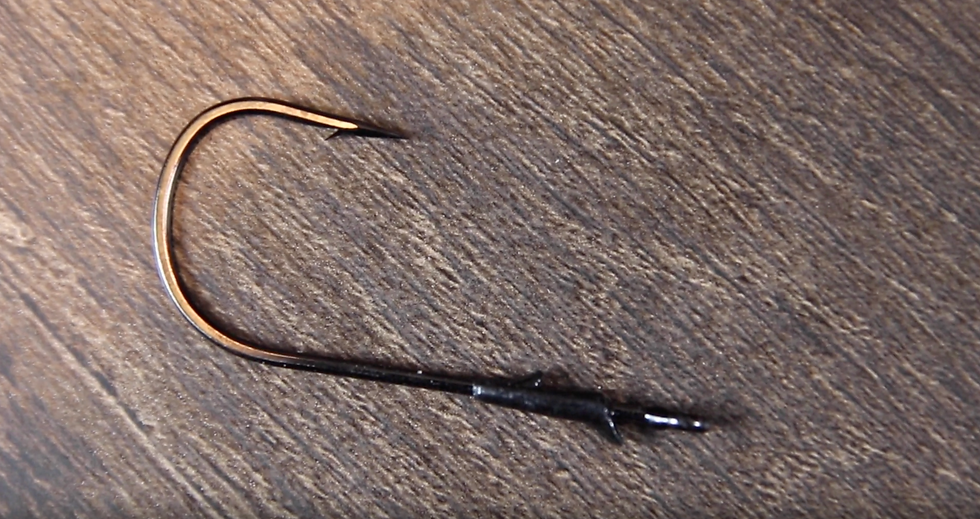
The straight shank hook has been around for a long time, and it's what was used for most everything for many years. These days the straight shank hook is most often used for flipping, pithing, and punching, as its design favors these techniques most. It's designed exactly like the name implies; it has a perfectly straight shank. This makes it perfect in vertical applications as the line has direct pull to the hook. That's just what you want when you're hooked into a big bass in thick cover.
In Conclusion
So the main takeaway here is you want to pay attention to a couple of variables when selecting the type of hook that best suits your needs. How thick is the soft plastic you're using? That will determine the size of the gap you want. Round bend offsets are great for slim profiles, EWGs are great for either slim or thicker profiles. Finally, what technique are you using? Are you going to be making long casts and retrieving (Texas rig/Carolina rig), or are you going to be in a more vertical situation like flipping and pitching in heavy cover? If you're in that close quarters, vertical scenario you might want to think about going with a straight shank flipping hook.
HOOK GAUGES
What we're really talking about when we refer to a hook's gauge is the thickness of the wire the hook is constructed with. Hooks can fall into a few categories in terms of thickness. You have your heavy duty hooks (thickest), your standard hooks (medium), and your light hooks (thinest). There are

some performance trade-offs on each side of the spectrum. Heavier hooks are going to be harder to set into a fish's mouth because the thicker wire just doesn't penetrate as well. Your lighter hooks are going to penetrate much more easily, but lack the strength to horse a big fish from thick cover. Standard hooks are really a happy medium, and are perfectly fine to use for most applications. There are other variables that will determine the gauge hook you'll want to use, mainly the type of setup you'll be using. Let's take a look at each gauge category and when it's appropriate to use each one.
Light Gauge Hooks
As previously mentioned, your lightest gauge hooks are going to be constructed of the thinest wire. The main reason you'd want to use a thin wire hook is for the increased hook penetration. This improved penetration, however, comes at a cost. Thinner wire bends out much more easily which makes using these hooks a gamble in certain situations. If you're hunting for bigger bass, you may want to go with a thicker wire. Because of its propensity to bend, you won't want to use these hooks with heavy tackle, i.e. heavy rod, strong braided line. A stout rod, and braided line with no stretch will overload the thin gauge hooks and bend them out on the hook set. Only use these with a rod and line that have more give.
Standard Gauge Hooks
Your standard gauge hooks are really your middle of the road, good, all around hooks. You'll achieve average hook penetration with these hooks with less risk of bending the hooks out under pressure. I still wouldn't recommend using these hooks with really heavy tackle like a heavy flipping rod with 65lb braid, but you can get away with a moderately heavy setup here. You do run the risk of having these bend out if you hook into a true monster, but it's totally doable to land large fish with standard gauge hooks as long as you properly play that fish and set your drag correctly. These are your best all purpose option.

Heavy Duty Hooks
These are the the thickest of the hooks, and they're what you turn to when you're going to be wrestling big fish out of thick slop. These are great for flipping, pitching, punching, or any situation where you're using a heavy setup in anticipation of hooking up with a mondo. Ideally, you do not want to use these hooks on anything other than a stout rod with heavy braided line. Anything less may not have the backbone needed to get a proper hook set due to the thicker gauge wire.
In Conclusion
So, when selecting the most effective hook for your application, remember, heavy hooks mean tougher hook penetration and require heavy setups with the necessary backbone to set the hook; lighter hooks provide maximum penetration, but require lighter setups that afford more give. If you're not in a situation where you anticipate putting heavy strain on your hook, you may be best served by using the standard hooks. Keep this in mind at the tackle shop. It's heart breaking to lose a fish because of a bent hook or to miss a fish because you couldn't get a good hook set.
HOOK LENGTH

You've all seen the numbers on a new hook's packaging, right? 1/0, 2/0, 3/0, 4/0, 5/0, and so on? Well that number refers to the length of the hook. The smaller the number, the shorter the hook. The way you determine which size will work best for you is to consider the size and type of the soft plastic you'll be using. There are a couple of simple rules to remember when dealing with length.
Firstly, if you're using a worm style lure, the bulk of the action that lure produces is in its tail. Using a hook that's too long for that lure will negatively effect the action. This is because a longer hook acts as a backbone, preventing movement of the lure along the length of the hook. So for worm style lures, use the shortest hook you can get away with while still ensuring you have enough length for a good hook set.
Now, that principle is quite the opposite for creature baits where the action is derived from the appendages. For those baits, use the longest hook the lure will accommodate. Since the appendages move independent of the body, the hook won't effect their movement. Using a larger hook will increase your odds of hooking up even if the fish doesn't totally engulf the bait.
CONCLUSION
So there you have it. Hook selection really doesn't have to be too difficult. Select the hook type based on the thickness of your soft plastic, and the technique you intend to use it for. Select the wire thickness based on your rod and reel setup, and whether or not you'll be putting stress on the hook. Then finally choose the proper length based on whether or not your action is derived directly from the tail of the lure, or from appendages acting independent of the lure body. Next time you hit the tackle shop, be sure to follow these simple principles and you'll be sure to choose the perfect hook for you and your setup.
Below is a video I made that follows this same topic. Be sure to like and subscribe to the channel! I'd love to have you support the channel.


Comments